Digital infrastructure needs digital connectivity
Telstra returned an explicit major cable and optic fibre warning for the search area, NBN separately identified communications assets, and on 5 September 2026 Telstra’s own warning post was photographed on the holding’s fence line reading “optical fibre cable in this vicinity”. The presence of carrier fibre at the boundary is now confirmed by the asset owner’s signage. It does not make the site carrier ready.
What the carriers said
“WARNING — MAJOR CABLES and/or OPTIC FIBRE IN THE AREA.” Telstra NSW South, Before You Dig Australia response, 26 August 2026. The detailed asset plan was not included in the consolidated response document and should be obtained separately.
NBN asset search results returned “Communications: Asset identified” and “Electricity: No assets”, confirming telecommunications facilities in the vicinity independently of Telstra.
Seen on the ground, 5 September 2026
A walk of the fence lines found Telstra’s own markers. A yellow warning post at a gate reads “optical fibre cable in this vicinity”, which is the asset owner naming the asset type in the field, something the BYDA response did not do. A series of numbered triangular markers gives the route direction along the fence and the offset to the cable, and an older Telecom Australia marker records the cable at 1.2 metres deep. The Telecom branding dates that route to before 1995, which suggests a long-established route rather than a recent local access build, and is the single most encouraging thing the inspection found. It is still not a capacity, a strand count or a second route.
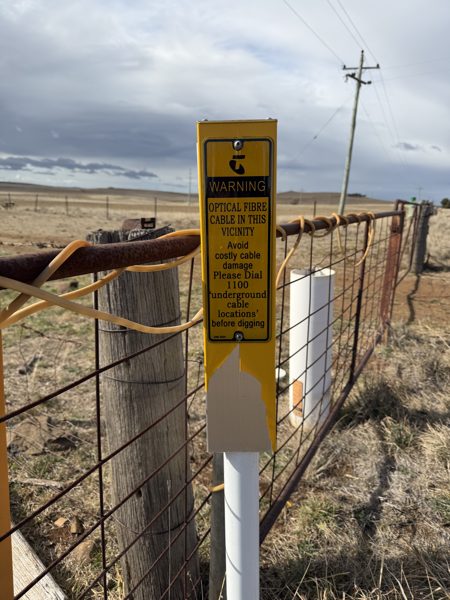
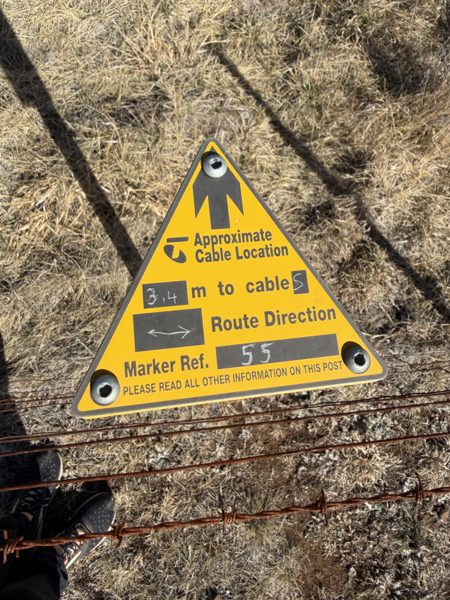
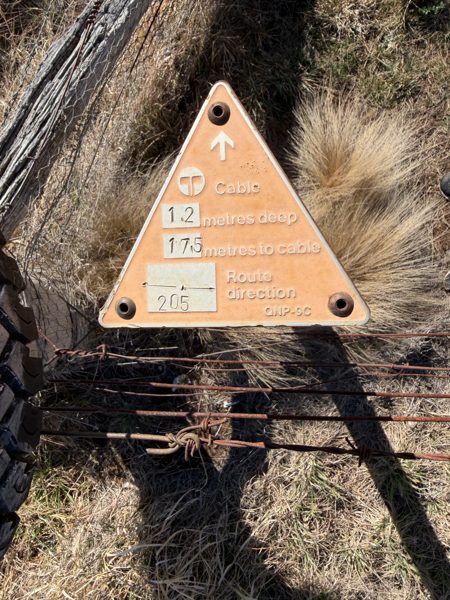
Photographs 5 September 2026, reproduced without alteration other than cropping and resizing. Marker positions are on the fence line and have not been surveyed.
Before You Dig is a utility location service, not a capacity service. These responses establish the presence and ownership of infrastructure. They do not establish fibre type, spare capacity, route role, diversity, connection cost or connection timing. Each of those requires a separate commercial enquiry to the carrier concerned. Telstra plans are valid for 60 days from issue.
What must be established
- Dark fibre and wavelength service availability
- Actual route role: is it a trunk, a backhaul route or local access
- Spare capacity, nearest splice point and carrier PoP locations
- Latency to Canberra, Sydney and Melbourne
- Route ownership and build distance for a second carrier
- Lead times and augmentation costs
The requirement that decides it
Two physically diverse fibre paths entering the campus from separate directions. A single high capacity route, however good, is insufficient for a major deployment.
The target is Carrier 1 plus Carrier 2, on physically diverse routes, with scalable multi-terabit capacity. Establishing what the identified infrastructure can actually deliver for a large digital load is a defined and tractable diligence exercise, and one a prospective operator or partner would ordinarily lead.
Source: Before You Dig Australia infrastructure enquiry responses for the investigated area, Job 54074165, including Telstra NSW South and NBN Co. Such records identify the presence of assets in an area and are indicative only; asset locations, capacity and availability must be independently confirmed.
The carrier and fibre feasibility report
Performance measure 12 of the NSW Data Centre Guidelines requires early engagement with telecommunications and optical fibre providers, including opportunities to share a common bank of underground conduits. The work already done identifying telecommunications infrastructure is therefore valuable. It is not yet the document an operator will ask for.
An operator or a counterparty's technical adviser will put nine questions, and the answer to each has to come from a carrier rather than from a location plan. Together they define a formal Carrier and Fibre Feasibility Report, which is the deliverable this workstream now has to produce.
| Question | Current position | Who answers it |
|---|---|---|
| Carrier | Telstra assets flagged; NBN assets identified. No other carrier established. | Telstra InfraCo or Wholesale; at least one independent carrier |
| Fibre type | Optical fibre, per Telstra’s warning post on the boundary. Strand count, generation and whether the sheath also carries copper are not established. | Telstra, from the detailed asset plan |
| Available strands and capacity | Not established. | Carrier serviceability assessment |
| Route | Marked on the ground along the fence line by numbered Telstra markers with route direction and depth (1.2 m). No route plan has been supplied; the corridor is drawn indicatively on the interactive plan for that reason. | Carrier route maps |
| Distance from site boundary | Not established. | Carrier, against the cadastral boundary |
| Latency to Sydney | Not measured. Geographic position between Canberra, Sydney and Melbourne is favourable; carrier performance is not. | Carrier, indicative then tested |
| Physically diverse second route | Not established. One corridor is strongly indicated; a second is not. | Second carrier, with route maps proving separation |
| Cost to extend | Not established. | Carrier build quotation |
| Lead time | Not established. | Carrier |
For a hyperscale opportunity, two genuinely diverse fibre paths are essential, not desirable. Diverse means physically separate routes entering the campus from different directions, with no shared conduit, pit, bridge crossing or point of failure between them. A report that establishes one excellent route and gestures at a second has not answered the question, and this is one of the two gating items that governs whether the project proceeds at scale.
What rarely sits on one holding, and what each fact does not yet establish
- Land
- up to 837.7 haAbout 2,070 acres across 11 lots as supplied. Room to investigate data halls, solar, storage and setbacks; the developable footprint is still to be established. The site →
- Scale
- 50 to 300 MWThe scale of data centre development being investigated, in stages. Not confirmed grid capacity. The opportunity →
- Electricity
- 132 + 66 kVBoth lines cross the holding on Lot 1, and regional wind already exports on the 132 kV. Available capacity is untested. Power →
- Gas
- Eastern Gas PipelineHigh pressure transmission main crosses Lot 1, confirmed present by Jemena. Pressure, offtake and terms are for Jemena to answer. Energy →
- Data and connectivity
- Optical fibre at the boundaryTelstra’s own fibre markers on the fence line, and an NBN asset identified. Capacity, diversity and carrier options to establish. Connectivity →
- Water
- Designed for low waterA cool climate at about 900 m may support closed loop or hybrid cooling. No supply has been demonstrated. Water →
- Location
- 10 km to CoomaA town of about 6,700 people, none of it within 4 km: potential access to workforce and services with separation from residential areas. Canberra 126 km, Sydney 406 km, Melbourne 630 km by road. Distance from Cooma →
- Renewables
- Wind on the line, solar to investigateBoco Rock wind exports on feeder 97R today. On-site solar and storage are opportunities to investigate; no supply is committed to this site. Energy →
Presence and position only. No electrical capacity, gas capacity, telecommunications service, water supply or planning approval is claimed, secured or offered.
Move from opportunity to feasibility
Rock Flat is seeking engagement with experienced digital infrastructure, energy and investment partners to undertake the next stage of technical and commercial feasibility. Detailed title, infrastructure, utility and commercial information is available to qualified parties.