Read as a caution
This is not a lightly loaded rural feeder. A 114 MW generator already uses it, so any assumption of idle headroom is unsupported. It also means load and generation must be assessed together, not separately.
A site inspection on 27 August 2026 identified the line. Asset plates read CE 253562 / 132Kv Fdr / 97R. It is Essential Energy's Cooma to Bega 132 kV line, and the poles are built for two circuits with only one strung.
“The Steeple Flat 132/66/22kV substation is owned by Essential Energy. It receives supply via a tee off the Essential Energy 97R Cooma to Bega 132kV line.” Essential Energy, Distribution Annual Planning Report 2025 (same wording in DAPR 2024). The “CE” prefix denotes Country Energy, which merged into Essential Energy in 2011.
Three consequences follow, and the first is a correction to earlier versions of this material.
| Finding | What it means |
|---|---|
| The line is an Essential Energy asset, not a Transgrid one | Transgrid owns the Cooma 132/66 kV bulk supply point and the lines running into it from Williamsdale and Munyang. Essential Energy owns the 132 kV lines running south from Cooma towards Steeple Flat, Bombala and Bega. Essential Energy is therefore the first counterparty for a connection here, with Transgrid entering upstream because 97R's source is the Cooma bulk supply point. |
| The line runs through the property, not past the district | Earlier assessments recorded a 132 kV corridor as serving the district, inferred from a neighbouring project's referral documents. A quotable asset number on a pole on the land is a materially stronger position: it can be put to the asset owner directly. |
| The structures are double circuit capable and only one circuit is strung | The poles carry three cross-arms with arm positions on both sides. One side carries suspension insulators and conductors. The other side is bare: no insulators, no conductors. |
A vacant second circuit position is a corridor advantage, not a capacity claim. It plausibly reduces or removes the items that usually dominate the lead time of a new line: corridor acquisition, easement negotiation and new-corridor environmental approval. That is engineering reasoning, not a published Essential Energy position.
It proves nothing about the thermal rating and present utilisation of 97R under normal and N-1 conditions; firm capacity at the Cooma bulk supply point and upstream; fault level and system strength; voltage and dynamic performance alongside the generation already on the feeder; whether the poles and foundations were designed for a second circuit under the standards in force today; or whether the vacant position is already reserved for a circuit Essential Energy has planned. Essential Energy states that hosting capacity is determined by modelling, measurement and historical data, with voltage and heat as the binding constraints.
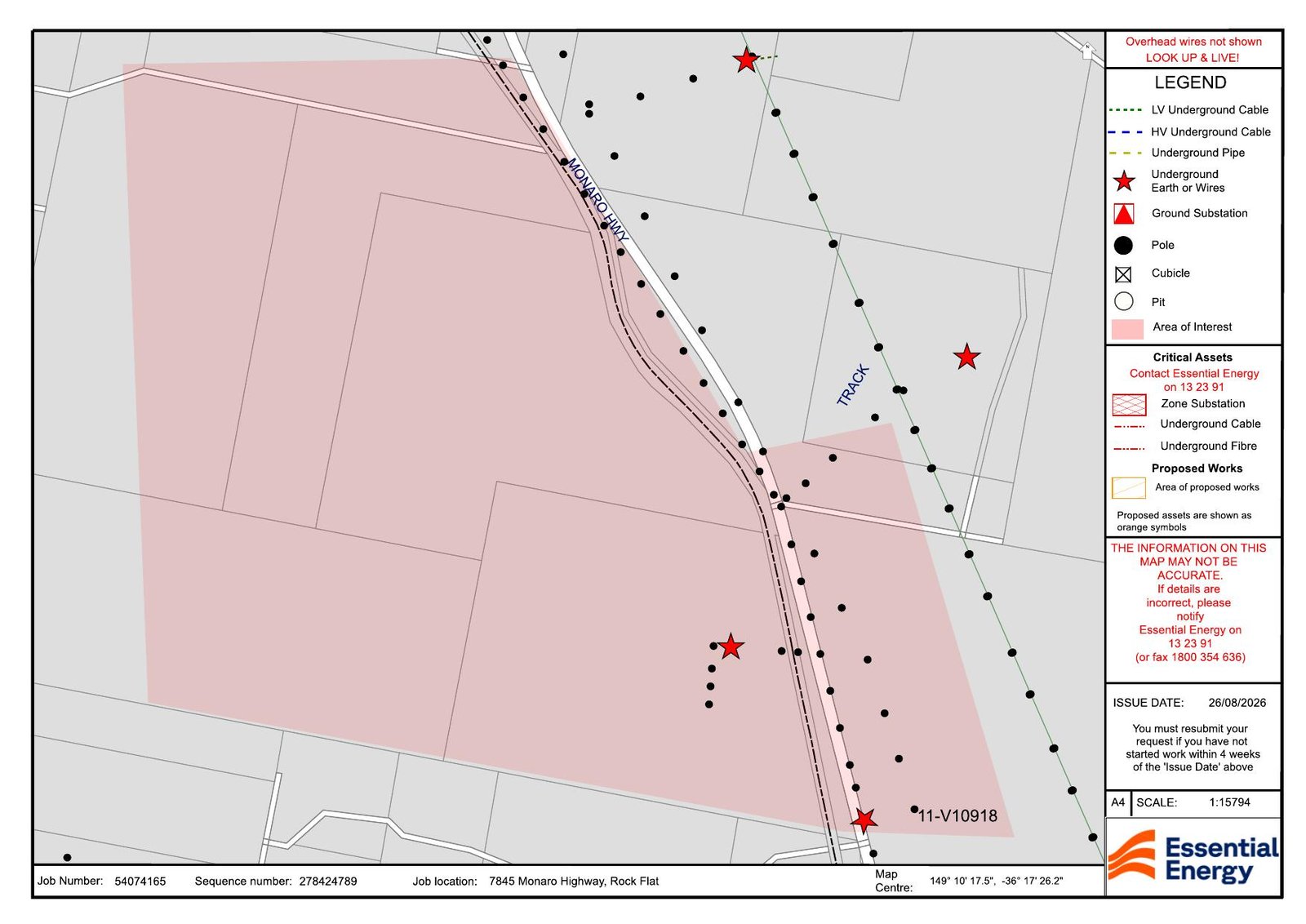
Photographic record of the pole infrastructure crossing the holding, cross-referenced against the Essential Energy plan issued under BYDA Job 54074165 on 26 August 2026.
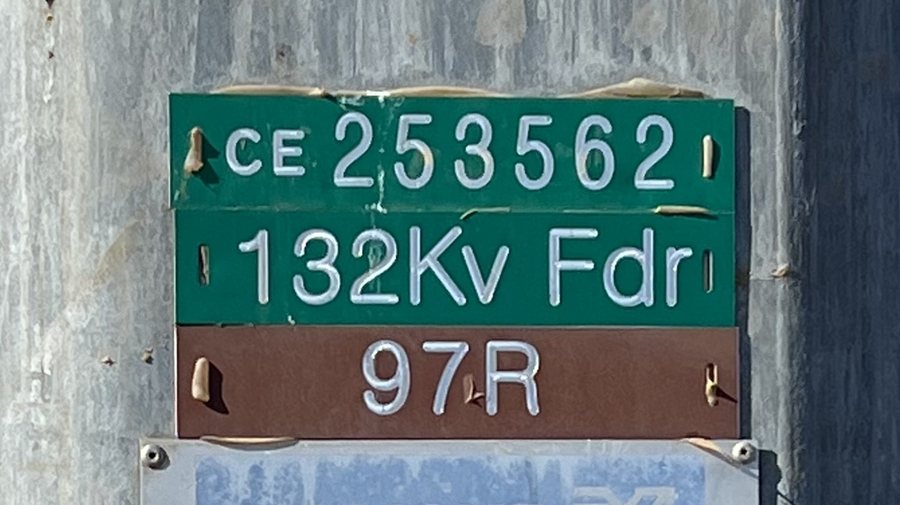
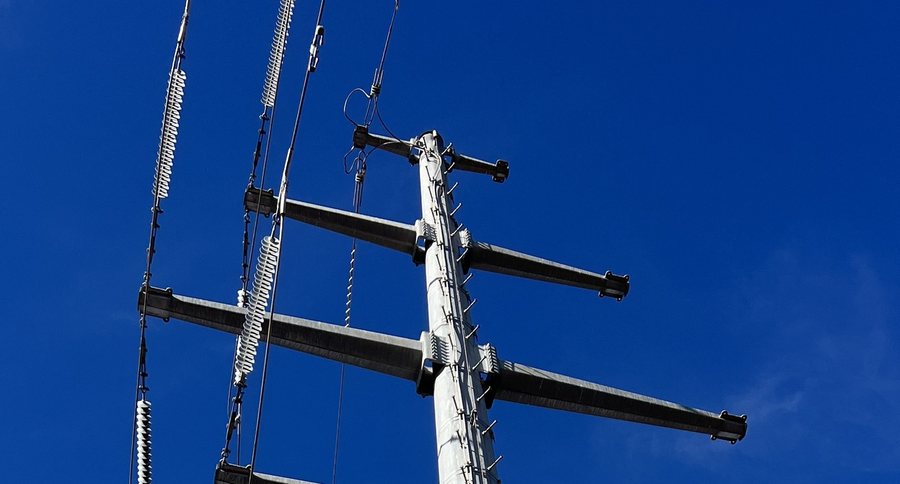
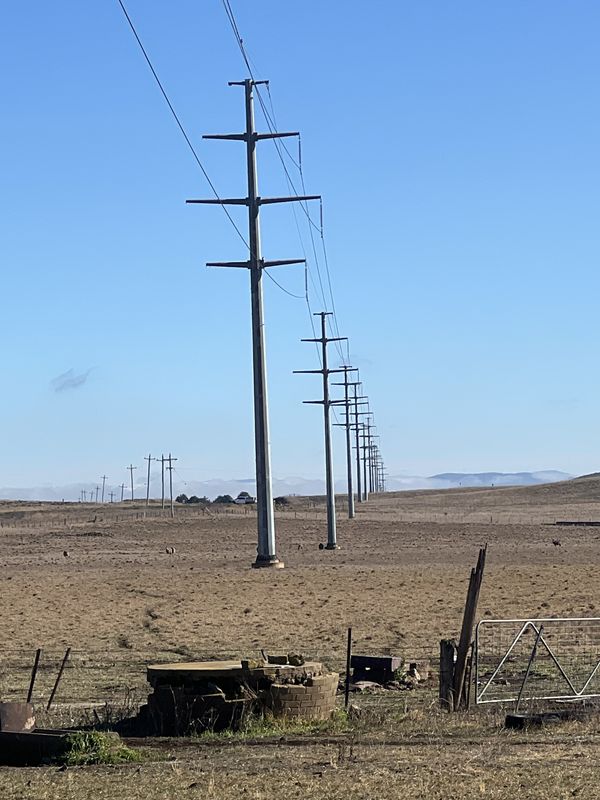
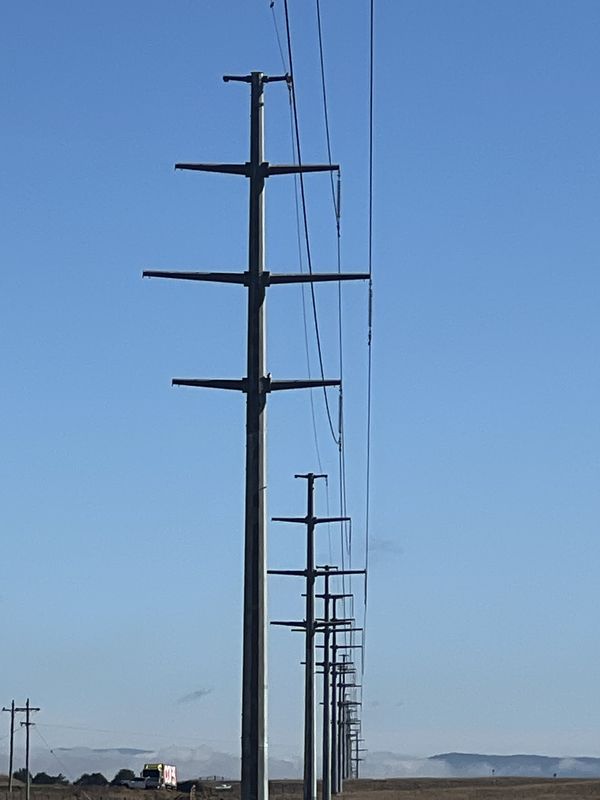
Essential Energy records that a 114 MW wind generator at Boco Rock is connected to Steeple Flat and exports to Cooma via feeder 97R, alongside a 5 MW hydro generator at Brown Mountain on the 66 kV system below it.
This is not a lightly loaded rural feeder. A 114 MW generator already uses it, so any assumption of idle headroom is unsupported. It also means load and generation must be assessed together, not separately.
Steeple Flat is a tee off 97R south of the site. Boco Rock's output therefore flows north past this property to reach Cooma. A large load at Rock Flat sits between the generation and the bulk supply point, so it would absorb that output locally and reduce, rather than add to, net flow at the Cooma end of the feeder.
This is also the arrangement NSW policy asks for. The August 2026 Data Centre Guidelines state that consumer bills “could potentially be reduced when data centre development occurs in parts of the energy network with spare capacity”, and that sites “close to energy generation, such as in the Renewable Energy Zones” require fewer upgrades. Performance measure 10 adds that data centres locating outside the Sydney Ring are “expected to have smaller contribution obligations”.
That second reading is a proposition to put to Essential Energy, not a conclusion this material can reach. If it holds, it is a strong one: it aligns with the AEMC's July 2026 recommendation that data centre demand be co-located with generation and backed by firm capacity. It also establishes precedent: Essential Energy has already built a tee and a substation on 97R for a large project. The connection being contemplated here is a variation on something the asset owner has done on this line before.
Transgrid's Williamsdale to Cooma 132 kV line 97D is recorded in an Australian Energy Regulator submission with a maximum design rating of 225 MVA at 85 °C. That is the only published rating found for any line in this chain, and it belongs to the transmission line feeding the Cooma bulk supply point rather than to 97R itself. It is a useful order of magnitude for the upstream limit and nothing more.
Neither Essential Energy nor Transgrid publishes a rating, a present utilisation or an available capacity figure for feeder 97R, for the Steeple Flat substation, or for the Cooma 132/66 kV bulk supply point. No megawatt figure for this site should be quoted, offered or relied upon until Essential Energy provides one in writing.
As a screening judgement only: 97R is a radial 132 kV subtransmission feeder serving Bega and Bombala with substantial generation already connected. A first stage in the tens of megawatts is a credible thing to ask about. A 200 to 300 MW campus is not a subtransmission proposition at all; it is a transmission one, requiring Transgrid, the Cooma bulk supply point and most likely the Cooma-Monaro renewable energy zone that Transgrid's 2025 planning report has already flagged as a candidate.
The site should not be presented as a committed 300 MW data centre. It should be presented as a credible first stage on a landholding that does not run out of room.
| Stage | Target firm capacity | What it unlocks | Principal dependency |
|---|---|---|---|
| Initial | 50 MW | First operating campus and revenue | Essential Energy: spare capacity on feeder 97R and connection cost |
| Expansion | 100 MW | Multi hall campus, credible operator scale | Feeder augmentation or a second circuit; on site generation and firming |
| Major campus | 200 MW | Precinct scale, energy co-location economics | Transgrid: Cooma bulk supply point and upstream transmission |
| Full opportunity | 300 MW+ | Regional digital infrastructure precinct | Transmission investment; candidate Cooma-Monaro REZ; long lead time |
Staging matches the 50, 100, 200 and 300 MW scenarios used throughout this site and recommended for the Essential Energy preliminary enquiry. No megawatt figure in this table is available, offered or confirmed. Cooling, conversion losses and facility overheads mean the connection requirement exceeds the IT load in each case. At each stage the NSW Guidelines also require the ability to shed 25% of grid load for up to two hours, sized on the energy page.
The electricity and energy questions in the FAQ →
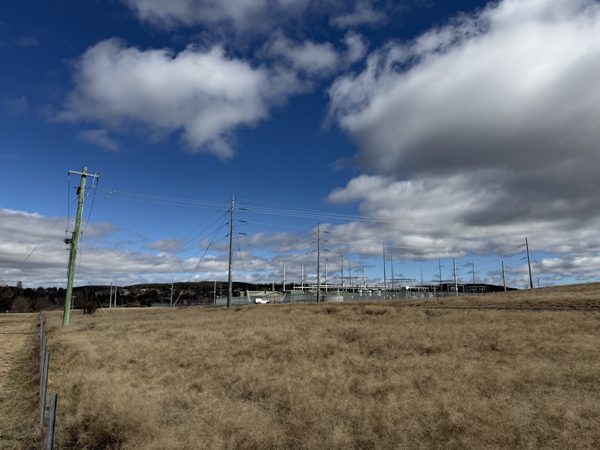
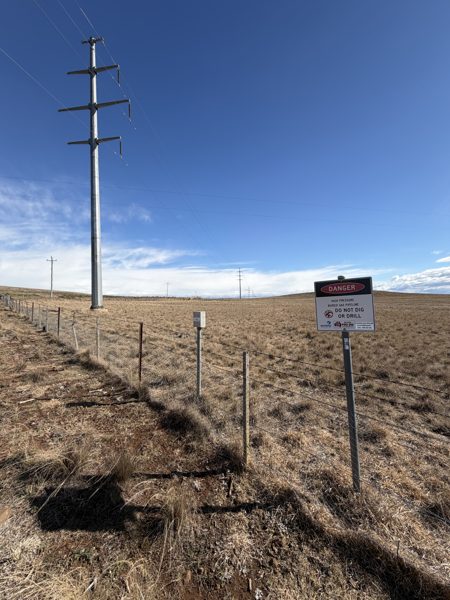
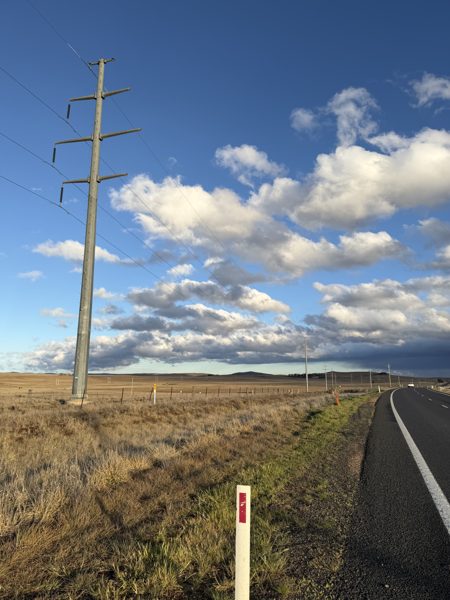
Photographs 5 and 6 September 2026. The substation identification is from location and configuration only; nothing in it establishes capacity.
Essential Energy publishes a seven-stage high voltage connection process: preliminary enquiry, detailed connection enquiry and investigation response, connection application and network studies, contract development, detailed design and construction, commissioning and energisation, then operations. The cost figures come from their embedded generator costing guideline and are indicative for a load connection, but they establish the order of magnitude of the connection asset, which the applicant funds.
The single most valuable action available. Lodge a preliminary enquiry with Essential Energy Major Network Connections, quoting asset number CE 253562 on feeder 97R and a staged 50, 100, 200 and 300 MW demand profile. The gating question it answers: can the network provide an economically viable initial 50 to 100 MW connection, expandable towards 300 MW?
The enquiry should also describe the demand flexibility the NSW Guidelines require, because a load that can shed a quarter of itself on notice, backed by on-site storage, is a different proposition to the network than a flat one. Around three months and modest cost separates this project from a written answer on the question that governs everything else.
“Capacity to connect to the transmission network in the Sydney basin is largely exhausted... new data centres or other large load customers will not be able to connect in this area without major network augmentation... there may be options to connect in other locations across the NSW transmission network.” Transgrid, Data centres and electricity capacity in NSW, current as at August 2026.
The Electricity Infrastructure Investment Amendment Bill 2026, part of the NSW Data Centre Policy Framework released in August 2026, would allow the Energy Minister to regulate grid connections for large loads with a network connection capable of transmitting 5 MW or more instantaneously. Any campus contemplated here sits well above that threshold.
Presence and position only. No electrical capacity, gas capacity, telecommunications service, water supply or planning approval is claimed, secured or offered.
Rock Flat is seeking engagement with experienced digital infrastructure, energy and investment partners to undertake the next stage of technical and commercial feasibility. Detailed title, infrastructure, utility and commercial information is available to qualified parties.