Energy

The differentiator most sites do not have

Jemena confirms in writing that works at this site could impact its high pressure Eastern Gas Pipeline. Combined with a grid connection, on-site solar, battery storage and the NSW wind power purchase agreement the Guidelines now require, that supports a layered energy precinct rather than reliance on any single source.

Gas is not a substitute for the renewable commitment, and it is not proposed as the primary long term electricity source. Its role is dispatchable generation, resilience, firming, emergency capability and precinct optionality. The NSW Guidelines themselves cite overseas models where proximate gas generation or battery storage supports major data centres.

The evidence

What the asset owner said

“We further confirm that your proposed work site could impact our high pressure gas main assets. Hence for the safety of your personnel and the security of our assets, no work is to be undertaken until confirmation is received that either your work site is a safe distance from our assets and/or a joint site meeting has been arranged to undertake your work across our facilities with safety.” Jemena Eastern Gas Pipeline, Before You Dig Australia response, 26 August 2026. Pipeline Section recorded as EGP Midline.

This is the strongest single item of evidence in the pack. It is an asset owner, in writing, placing a high pressure transmission pipeline in a position where it could be affected by works across this site. It is also a constraint: the pipeline that creates the opportunity also constrains the campus layout, through easements and the requirements of the Transport and Infrastructure SEPP.

Eastern Gas PipelineSpecification
OperatorJemena Eastern Gas Pipeline (1) Pty Ltd and (2) Pty Ltd
TypeHigh pressure gas transmission pipeline, Longford to Sydney; commissioned 2000
Length796.69 km mainline; 822.42 km including laterals
Normal operating pressure3,000 kPa to 16,550 kPa gauge
Capacity north350 TJ/day into New South Wales (existing capability)
Capacity southUp to 200 TJ/day towards Victoria (bidirectional works completed 31 March 2026)
Local deliveryCooma is an existing EGP delivery point; AEMO service point 1202009
Section at this siteEGP Midline, per the Jemena BYDA response of 26 August 2026
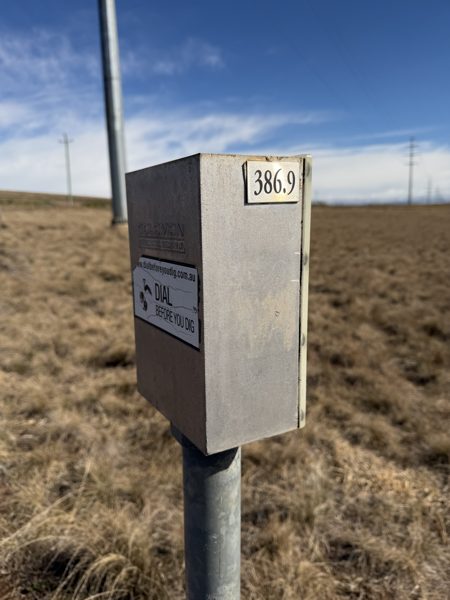
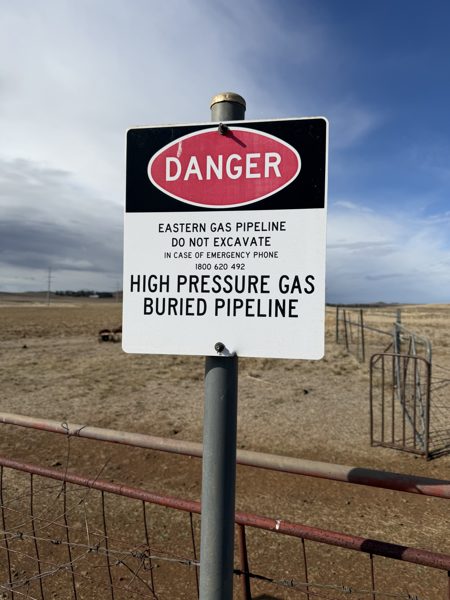
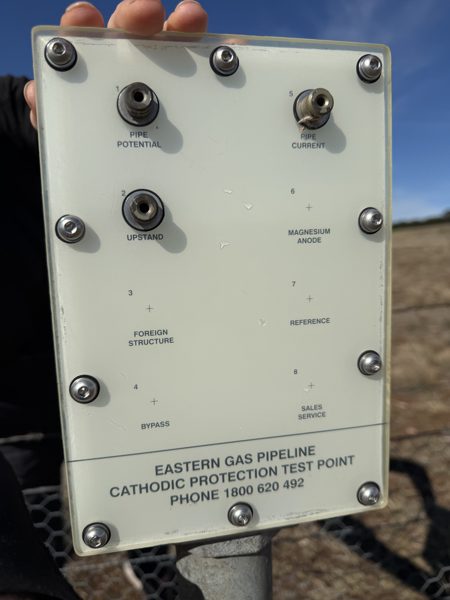
Seen on siteJemena danger signage, a cathodic protection test point and a marker post reading 386.9 on the fence line, photographed 5 September 2026

Seen on the ground, 5 September 2026

The pipeline is not only on Jemena’s plan; it is marked on the holding by Jemena. A danger sign on the fence line names the Eastern Gas Pipeline, a cathodic protection test point stands on the holding, and a marker post is numbered 386.9, read as a chainage figure to be confirmed with Jemena. In one frame the danger sign and the 132 kV steel pole line share the same fence, which is the physical form of what Appendix B of the executive summary calculates from the cadastre.

A white and red Danger sign on a steel post reading Eastern Gas Pipeline, do not excavate, high pressure gas buried pipeline, with open paddocks behind.
Jemena signage on the fence line. “Danger. Eastern Gas Pipeline. Do not excavate. High pressure gas buried pipeline.” Physical confirmation of the asset the BYDA response described in writing.
A cream coloured test point panel labelled Eastern Gas Pipeline cathodic protection test point, with terminals for pipe potential and pipe current.
Eastern Gas Pipeline cathodic protection test point. Operational pipeline infrastructure on the holding, which places the pipeline itself, not just its easement, within reach of the fence.
A galvanised marker post with a metal box reading 386.9 and a Dial Before You Dig sticker, with the 132 kilovolt pole line on the horizon.
Pipeline marker post 386.9. Read as a chainage marker along the pipeline; the figure is to be confirmed with Jemena. The 132 kV pole line is visible on the horizon behind it.

Photographs 5 September 2026, reproduced without alteration other than cropping and resizing. Signage confirms the asset’s presence and ownership. It says nothing about pressure at the site, offtake capacity or the cost of a delivery point, which remain the Jemena commercial enquiry.

Screening arithmetic

What a gas-fired campus would actually consume

AEMO generator parameters give approximately 7.8 GJ/MWh for combined cycle, 8.8 GJ/MWh for reciprocating gas engines and 11.1 GJ/MWh for open cycle, so a screening band of 7 to 11 GJ/MWh sent out covers the plausible technology set.

Continuous generationIndicative gas rateEquivalent daily volumeShare of EGP northbound capability
50 MW350 to 550 GJ/hour8.4 to 13.2 TJ/day2% to 4%
100 MW700 to 1,100 GJ/hour16.8 to 26.4 TJ/day5% to 8%
200 MW1,400 to 2,200 GJ/hour33.6 to 52.8 TJ/day10% to 15%
300 MW2,100 to 3,300 GJ/hour50.4 to 79.2 TJ/day14% to 23%

Screening assumptions only. These are not confirmed Jemena supply capacities; no capacity has been requested or offered. Share is calculated against the stated 350 TJ/day northbound capability of the whole pipeline.

What this table actually proves

A 300 MW campus running continuously on gas would consume between one seventh and one quarter of the entire northbound capability of a pipeline that serves New South Wales. That is not a realistic baseload proposition, and stating so is the point. Gas here is credible as a firming, resilience and bridging fuel at meaningful scale, and credible early, while grid augmentation runs on a longer timeline. It is not a substitute for a transmission connection.

Energy architecture

Build the energy system with the data centre

The next generation of large-scale digital infrastructure cannot be considered apart from the energy system that supports it. The appeal of this site is not a claim that hundreds of megawatts are already available. It is the ability to investigate several complementary energy pathways in one location, at a scale that allows them to be designed together from the outset.

Grid connection

A 132 kV feeder, identified on site as Essential Energy’s Cooma to Bega line 97R, crosses the holding on double-circuit-capable poles with the second circuit position vacant, with 1,467 m of it inside Lot 1 DP500662. A 114 MW wind project already exports on this feeder, so available capacity and connection options require formal investigation.

Regional wind

Wind generation operates in the district: Boco Rock, 114 MW, exports north to Cooma on the same 132 kV line that crosses this holding, and the locality is a candidate Renewable Energy Zone. A future operator could investigate the wind power purchase agreements the NSW Guidelines now require. No generator has committed supply to this site.

On-site solar

The holding has room to investigate on-site solar at scale beside the compute load, with about 642 ha clear of the three energy corridors before constraints. The solar footprint and its output are feasibility items; no capacity is stated. The NSW Guidelines add a wind requirement: at least 40% of contracted renewable energy, by MWh, must be wind, on ten-year agreements with projects not yet at final investment decision.

Battery storage

Battery storage is now sized by policy rather than preference: 25% of grid load for two hours of demand flexibility, and storage equal to 25% of contracted generation capacity for four hours. Both envelopes are set out below. They are policy envelopes, not an engineered size.

Gas-backed resilience

The Jemena Eastern Gas Pipeline runs 1,348 m through Lot 1 DP500662. That creates an opportunity to investigate gas-supported resilience, emergency generation and firming, not a baseload gas proposition, and a design principle of avoiding routine diesel storage on site. Pressure, offtake, connection and terms are Jemena’s to answer, and none has been requested.

Reliable, flexible digital infrastructure

Regional wind, on-site solar, a grid connection, battery storage and gas-backed resilience, combined as one precinct and staged to match load growth. Not solar plus grid, which the Guidelines no longer reward on its own. A potential architecture, subject to feasibility.

No capacity is claimed. No particular megawatt capacity is represented as currently available at this site. Each pathway above is presented as a subject for formal technical and commercial investigation. The proposition is not that electricity is available here; it is that the compute load and its supporting energy ecosystem can be designed together, a precinct that brings its infrastructure with it. The electricity, gas and renewable energy questions in the FAQ set out what is known and what is not.

Grid flexibility and storage

What the NSW Guidelines size at each stage

Two performance measures translate directly into a design envelope for the precinct. Both reward land, and both are easier to satisfy on this holding than on a constrained metropolitan site. This is probably the biggest change the Guidelines make to the proposition.

Measure 9: reduce grid-supplied load by 25% for up to two hours

Flexible capacity and two-hour energy equivalent at each campus stage under performance measure 9
Campus load25% flexible capacityTwo-hour energy equivalent
50 MW12.5 MW25 MWh
100 MW25 MW50 MWh
200 MW50 MW100 MWh
300 MW75 MW150 MWh

The Guidelines set a hierarchy: load shifting first, then on-site or proximate renewable generation and storage, with the notice period agreed with the utility and AEMO able to instruct a reduction. Diesel back-up generators cannot be used for this measure. A metropolitan facility may struggle to find room for a battery of the size the Guidelines’ rules would imply beside its data halls; here it can be laid out from day one.

Measure 13: storage of at least 25% of contracted generation capacity, for four hours

Indicative minimum storage power and duration at each campus stage under performance measure 13
Data centreIndicative minimum storage powerIndicative storage energy, four hours
50 MW12.5 MW50 MWh
100 MW25 MW100 MWh
200 MW50 MW200 MWh
300 MW75 MW300 MWh

Very approximate, and assumes contracted generation capacity is matched to campus load. The Guidelines link storage to the contracted generation portfolio rather than to IT load, so the final calculation will not be this simple. Storage can be battery or pumped hydro, part of a hybrid asset or separate, and on-site storage provided for demand flexibility under measure 9 can count towards this measure. No storage, generation or PPA exists; this is a design envelope for feasibility.

Policy alignment

Why co-located generation matters more than it used to

The AEMC finalised its data centre advice to energy ministers on 28 July 2026. It recommended that data centres surrender renewable energy certificates from new additional generation, demonstrate that their demand is backed by new firm capacity, register as market participants, and enter connection agreements that encourage demand shifting and co-location with generation.

A site that can host its own generation and firming on the same title is positioned for that framework rather than exposed to it. Separately, electricity generating works have a clearer rural planning pathway than the data centre use itself, which means the energy component may be able to progress on a different and faster track. That is set out on the planning page.

What the NSW Guidelines ask of the energy component

Principle 3 of the August 2026 NSW Data Centre Guidelines is the most prescriptive thing in the document, and it is where land area stops being an abstraction. Performance measure 13 asks a proponent to contract additional renewable generation in NSW, with:

  • a minimum 40% wind component by energy;
  • storage of at least 25% of generation capacity, for a four hour duration;
  • contracted supply matching average annual demand from the fourth year of operation;
  • agreement terms of at least ten years; and
  • projects that have not yet reached a final investment decision, so the generation is genuinely additional.

For most sites the binding constraint on that measure is somewhere to put the generation. This holding has the room, on the same title, and on-title solar and storage are additional by definition. The district is also demonstrably wind-viable, which is what the 40% component needs.

This is an obligation, not a windfall

Ten-year offtake agreements over pre-FID generation, with four-hour storage attached, are a material commercial commitment and are not costed anywhere in this pack. The site offers the physical capacity to satisfy measure 13. It has not satisfied it, and presenting proximity to generation as an advantage while passing over the obligation that comes with it is a selective reading a counterparty will notice.

What the Jemena commercial enquiry must establish

The question for Jemena is now specific: at what pressure, flow rate and connection cost could the nearby pipeline support 25 MW, 50 MW, 100 MW or potentially greater generation? Around it sit the pipeline alignment and easement position relative to the developable area; feasibility of a new industrial delivery point at or near Rock Flat; available pressure and permissible delivery volume at the demand profiles above; lateral, metering and regulation requirements; connection cost and timeframe. This is a commercial conversation with the Jemena EGP team, separate from the Before You Dig safety channel.

Gas is a defined feasibility workstream, and a valuable one. It is not one of the four gating questions: the project does not necessarily fail if gas cannot be developed, whereas it almost certainly fails as a 100 MW plus opportunity without grid capacity or diverse fibre. Water now ranks ahead of gas in the feasibility priority list. The Guidelines page sets out that ranking.
The key facts

What rarely sits on one holding, and what each fact does not yet establish

Land
up to 837.7 haAbout 2,070 acres across 11 lots as supplied. Room to investigate data halls, solar, storage and setbacks; the developable footprint is still to be established. The site →
Scale
50 to 300 MWThe scale of data centre development being investigated, in stages. Not confirmed grid capacity. The opportunity →
Electricity
132 + 66 kVBoth lines cross the holding on Lot 1, and regional wind already exports on the 132 kV. Available capacity is untested. Power →
Gas
Eastern Gas PipelineHigh pressure transmission main crosses Lot 1, confirmed present by Jemena. Pressure, offtake and terms are for Jemena to answer. Energy →
Data and connectivity
Optical fibre at the boundaryTelstra’s own fibre markers on the fence line, and an NBN asset identified. Capacity, diversity and carrier options to establish. Connectivity →
Water
Designed for low waterA cool climate at about 900 m may support closed loop or hybrid cooling. No supply has been demonstrated. Water →
Location
10 km to CoomaA town of about 6,700 people, none of it within 4 km: potential access to workforce and services with separation from residential areas. Canberra 126 km, Sydney 406 km, Melbourne 630 km by road. Distance from Cooma →
Renewables
Wind on the line, solar to investigateBoco Rock wind exports on feeder 97R today. On-site solar and storage are opportunities to investigate; no supply is committed to this site. Energy →

Presence and position only. No electrical capacity, gas capacity, telecommunications service, water supply or planning approval is claimed, secured or offered.

Next step

Move from opportunity to feasibility

Rock Flat is seeking engagement with experienced digital infrastructure, energy and investment partners to undertake the next stage of technical and commercial feasibility. Detailed title, infrastructure, utility and commercial information is available to qualified parties.